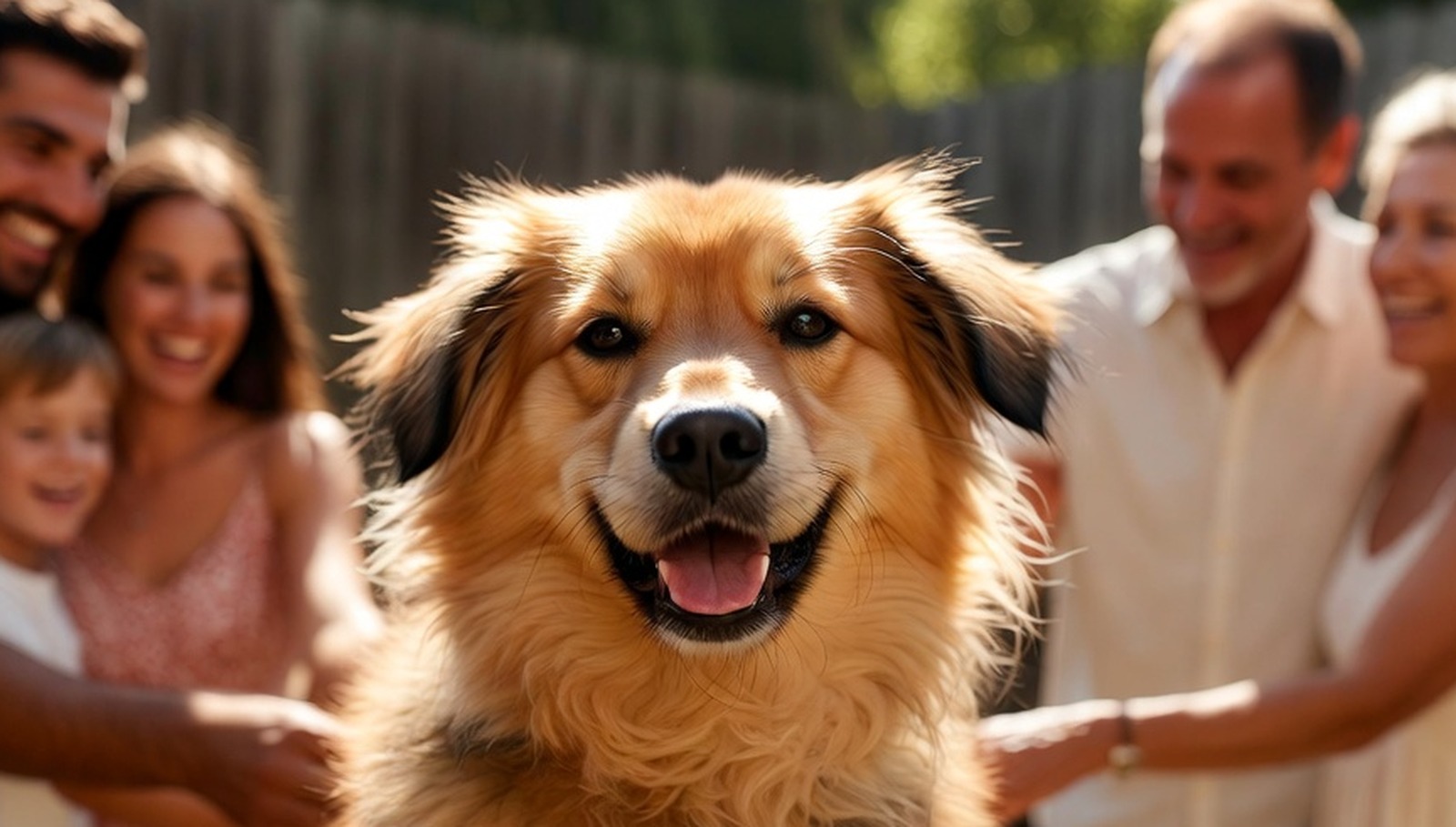
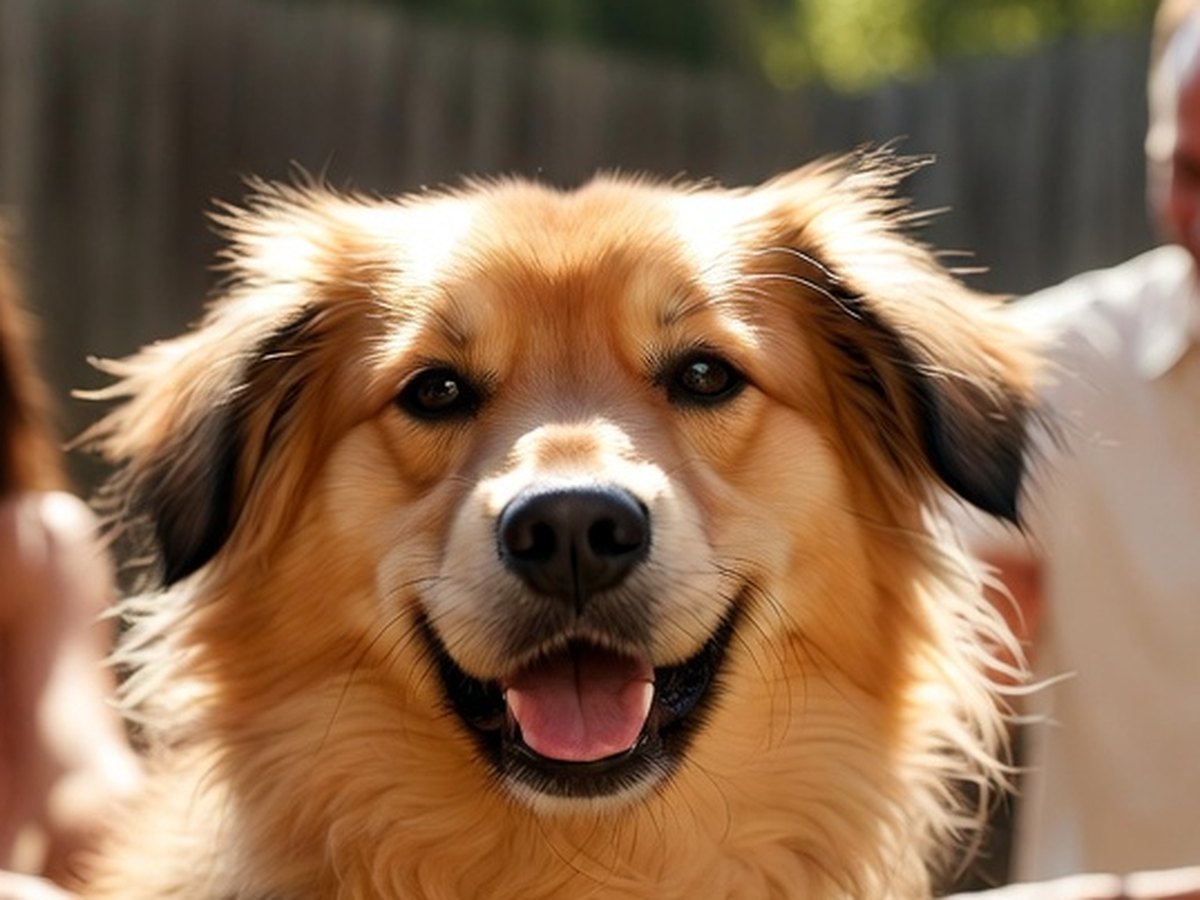
About Tillman
- Breed
- Golden retriever mix
- Age
- About 6 years
- Size
- 64 lb, medium-large
- Coat
- Long golden, darker ears, needs brushing twice a week
- Energy
- Medium — a walk and a yard, not a running partner
- Housetrained
- Yes, fully
- Good with
- Kids, other dogs, and a cat he lives with now
- Thrives with
- Company. He is a people dog — happiest with someone around, another dog for the day, or a second household so his week always has somebody in it.
- Working on
- Loose-leash walking. He is enthusiastic about going places and we are teaching him to do it politely.
- Found
- Stray, Raleigh-Millington Rd · intake March 2025
His story

Somebody called him in from a car. He'd been living behind a strip mall off Raleigh-Millington for long enough that his coat had matted into cords, and he wouldn't come out from beside the dumpster for two days. That photo is day one.
He put on eighteen pounds, grew the coat back, and turned out to be the easiest dog in the building. He is named Tillman and this rescue is named after him, because he is the dog everybody almost drove past.
What he needs is simple. He is a people dog. He is at his best with company in the house — someone working from home, another dog for the day, or two households sharing his week so there is always somebody in it. Give him that and he is the easiest dog in the building.
What's included
- Spay or neuter — already done, already healed
- Vaccines current — rabies, DHPP, bordetella
- Microchipped and registered — transferred to your name at pickup
- Heartworm tested and on prevention
- Two weeks of food so you can switch gradually
- Lifetime behavior support — call us at any hour, for as long as you have him
- A door that stays open — if it ever stops working, he comes back to us. No penalty, no questions.
Four ways to say yes
This is the one we'd push for Tillman, because company is what he loves most. Two households, alternating weeks: there is always somebody with him, neither of you pays full freight, and neither of you ever boards a dog again — on your travel weeks he just goes to his other house. We keep the title and cover his vet bills, and either of you can step out at any point.
$0 · we cover the costsHe's yours. Full records transfer, lifetime behavior support, and a return clause that never expires.
$175 adoption feeA few weeks in a house instead of a run. We cover food, vet, and the crate. You cover the couch.
$0 · we cover the costsCan't take him home? Cover food and heartworm prevention until someone can. You get the photos and you get to find out how it ends.
$25 / monthTraining & settling in
Every dog that leaves us comes with this, plus our phone number for as long as you have him. Most of what people call a "behavior problem" is a dog who hasn't been shown the answer yet — and almost all of it is fixable in a few weeks of five-minute sessions.
The first two weeks — the 3-3-3 rule
- First 3 days — decompression. He may sleep a lot, eat little, or shadow you everywhere. Keep it boring on purpose. No visitors, no dog park, no big outings.
- First 3 weeks — settling. The real personality shows up and routines start to stick. This is when you begin training, not before.
- First 3 months — home. He understands this is his. Confidence arrives, and so does the occasional test of the rules. Normal, and it passes.
Six things worth teaching, in this order
- His name — he looks at you, he gets paid. That's the whole exercise, and everything else builds on it.
- Sit — the default polite behavior. Ask for it before food, doors, and greetings.
- Recall — the one that saves a life. Say it once, make it a party every single time.
- Leave it — chicken bones, pill bottles, the thing on the sidewalk. Second most useful cue there is.
- Place / settle — go to a mat and stay. Solves jumping on guests, begging at the table, and the doorbell, all at once.
- Loose-leash walking — the slowest to build. Worth every session.
How training actually works
- Five minutes, three times a day beats an hour on Sunday. Dogs learn in short reps.
- Mark the exact second they get it right — a clicker or a sharp "yes!" — then pay. Timing matters more than the treat.
- Pay well for hard things. Kibble for sit in the kitchen. Real chicken for coming back at the park.
- Set them up to be right. If they can't do it, make it easier until they can. Repetition of success is the whole method.
- Never call them for something they dislike. Don't use recall to end the walk, trim nails, or crate them. Go get them instead. One shortcut here costs months.
- End while they're still winning. Stop a rep early, not a rep late.
If something isn't working
When to bring in a pro
- Look for reward-based trainers with real credentials — CPDT-KA, KPA-CTP, IAABC, or a veterinary behaviorist (DACVB) for anything involving fear or aggression.
- Walk away from anyone who explains your dog with "dominance" or "alpha," or who reaches for a prong or shock collar first. Both suppress the warning without changing the feeling, and a dog who has learned not to growl is a dog who bites without warning.
Apply for Tillman
Share him · print a flyer

Point a phone camera at this to open Tillman's page.
Screenshot it, text it, or print a flyer for a noticeboard.